


If an AI shopping assistant suggested a cheaper alternative to a grocery product you regularly buy, would you give it a try?
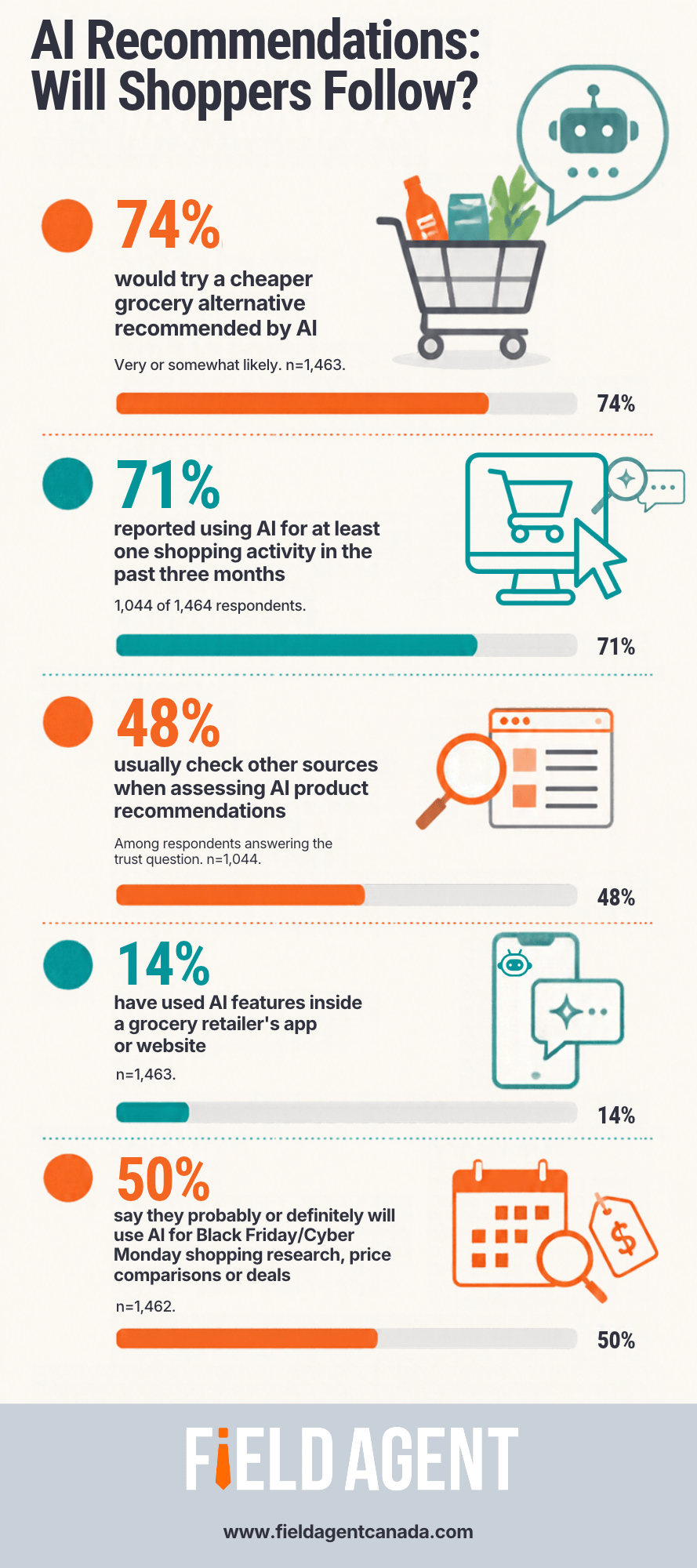
In our latest survey, 74% of respondents said they would be very or somewhat likely to try it.
For CPG brands, that is a reason to pay attention. AI recommendations could create opportunities to win trial, and give existing customers a reason to consider something else.
In our recent blog, Is AI Recommending Your Brand? A New Question for Canadian CPG Companies, we explored why brands need to understand how their products appear in AI-generated recommendations, alongside traditional search results.
We followed up with a survey of 1,464 members of our Field Agent community to learn how they use AI for shopping, how much they trust its recommendations and whether those suggestions could influence their choices.
The findings point to an opportunity for brands: understand what earns a recommendation, then make sure shoppers can verify the information and find the product.
AI is already part of shopping research for many respondents
71% of all respondents reported using an AI chatbot or personal assistant for at least one shopping-related activity in the past three months. That represents 1,044 of the 1,464 people surveyed.
Among the 1,262 current AI users who answered the shopping-activities question, 52% had researched products before purchasing, while 44% had compared brands or products. Respondents could select multiple activities.
This is relevant to brands because the research stage is where shoppers can discover options, weigh competing claims and decide which products deserve a closer look.
Our survey does not establish that these conversations resulted in purchases but it does show that AI is already being used to help evaluate shopping choices.
A cheaper recommendation could open the door to trial
Asked about trying a less expensive grocery alternative identified by an AI shopping assistant, 25% said they would be very likely and 49% somewhat likely—a combined 74% of the 1,463 respondents answering that question.
That is stated willingness to try a product, rather than evidence that shoppers have already switched brands. Even so, it highlights a useful question for brand teams: when shoppers ask AI for better value, does your product enter the conversation?
For a challenger brand, a relevant recommendation could introduce a product to someone who has never considered it. For an established brand, it is a reason to understand how its value proposition holds up when shoppers explore alternatives.
Price is the condition in this particular question. Brands should also investigate what shoppers need to know about pack size, quality, ingredients and performance before accepting a suggested alternative.
Trust often comes with a second check
Being recommended does not end the decision process.
Among the 1,044 respondents who answered the trust question, 48% said they somewhat trust AI product recommendations but usually check other sources. Another 36% said they mostly trust them and occasionally verify the information. Just 7% said they completely trust them and rarely verify.
That makes the information shoppers encounter after a recommendation especially important. Does the retailer listing show the correct pack size? Do the ingredients and nutrition details match the product? Are price and availability accurate?
A recommendation may prompt interest, but inconsistent information can give shoppers a reason to hesitate. Brands need to consider both the AI response and the sources shoppers use to check it.
Grocery-app adoption still has room to develop
General-purpose chatbots and AI features built into grocery apps are different experiences, and our results reflect that distinction.
Only 14% of the 1,463 respondents answering the grocery-app question said they had used AI-powered features within a grocery retailer’s app or website.
Another 27% had noticed these features without using them, while 27% used grocery apps or websites but had not noticed AI features.
This suggests room for retailers to explain and demonstrate these tools. For brands, it also reinforces the need to understand where AI-assisted discovery is happening, rather than treating every AI shopping experience as the same channel.
Black Friday offers a timely opportunity to learn
Looking ahead to Black Friday and Cyber Monday, 50% of the 1,462 respondents answering that question said they probably or definitely would use AI to research products, compare prices or find deals.
These are intentions, not confirmed holiday-shopping behaviours. They nevertheless give brands and retailers a timely reason to investigate the recommendations shoppers receive during promotional periods.
Are products described accurately? Are advertised offers easy to verify? Do recommended items remain available when shoppers try to buy them?
Start with the shopper’s question
Our original blog asked whether AI is recommending your brand. This follow-up adds another consideration: shoppers may be willing to explore the alternatives AI puts in front of them.
We recommend starting with a few practical research questions:
- Visibility: Which brands appear when shoppers ask for value, convenience or products that meet a particular need?
- Accuracy: Do recommendations match current product details, prices and offers?
- Confidence: What do shoppers check before trusting a suggestion?
- Availability: Can they actually find and buy the recommended product?
At Field Agent Canada, we help brands understand shopper decisions through shopper research and investigate store-level execution through retail audits and price checks. Together, these approaches can help connect what shoppers are considering with what they encounter when they try to buy.
Want to understand how AI recommendations could affect consideration of your brand? Contact us to discuss research into your shoppers, category and retail experience.